
10 Ways to Make Bedtime Stories Interactive
You don’t need to turn bedtime into a big performance to keep your child engaged. A few small changes - like asking one question, letting your child pick between two calm choices, or adding a soft character voice - can make storytime more shared while still keeping the room sleepy.
I’d sum up the article like this:
- Start personal. Use your child’s name, interests, or a story that feels close to their world.
- Keep interaction simple. Ask open questions, offer small choices, and let your child fill in short parts.
- Use gentle play. Soft voices, quiet sound effects, slow movements, and one or two props can help.
- Connect stories to feelings. Short check-ins about emotions or daily life can help children put words to what they feel.
- End calm. As bedtime gets closer, make everything shorter, softer, and more predictable.
The article also points to a few data-backed ideas: interactive reading can help with engagement and understanding, and personalized stories may keep children engaged 2.5x longer than standard stories of the same length. It also suggests keeping any follow-up activity to about 5–10 minutes so sleep stays the goal.
Here’s the full list covered in the piece:
- Use personalized stories as a starting point
- Make your child the main character
- Turn the story into a choose-your-own-adventure
- Ask open-ended questions while you read
- Add sound effects and character voices
- Act out key moments with gentle movements
- Use props, stuffed animals, and simple puppets
- Invite your child to help tell the story
- Connect the story to real life and feelings
- Extend the story beyond the page in calm ways
Quick Comparison
| Idea | Best Use | Energy Level | Main Goal |
|---|---|---|---|
| Personalized stories | Easy starting point | Low | Help the child feel included |
| Main character swap | Kids who like hearing their name in the story | Low | Pull them into the plot |
| Choose-your-own-adventure | Kids who want some control | Low to medium | Shared decision-making |
| Open-ended questions | Talkative kids | Low | More back-and-forth |
| Voices and sound effects | Kids who like playful reading | Low to medium | Hold attention |
| Gentle acting | Wiggly kids | Medium | Add body movement without getting too wild |
| Props and puppets | Kids who like holding objects | Medium | Make the story hands-on |
| Child-led storytelling | Kids who like talking and making things up | Medium | Build story skills |
| Real-life feeling links | Kids working through big feelings | Low | Help with emotion words |
| Calm follow-up activity | Kids who want “one more thing” | Low | End softly |
If I were using this tonight, I’d keep it simple: pick one story, ask one question, offer two calm choices, and end with the same bedtime phrase each night.
Why Interactive Bedtime Stories Work
When you read with your child, they stop being just a listener and start taking part in the story. That’s the heart of dialogic reading. And it matters because that back-and-forth helps build language, empathy, and a sense of calm.
Interactive reading helps with language growth because children hear more words, answer more often, and try new vocabulary in context. That same exchange also helps them picture what’s happening and stay mentally inside the story instead of drifting off.
The back-and-forth also supports brain development through repeated attention and response. When children answer for a character, they practice stepping into someone else’s shoes. That gives them a safe, familiar way to build empathy.
Small cues can make a big difference at bedtime. Dim lights, a familiar chair, and a soft voice help children settle down and push back less when it’s time for sleep. A calm setup keeps story time playful without tipping into overstimulation.
These methods can work with any book, digital story, or even a few simple props. And they’re easiest to bring to life with a handful of simple storytelling techniques.
sbb-itb-d6d0693
1. Use Kidooki Personalized Stories as a Starting Point
Begin with a personalized story, then add one small interactive moment at a time. Kidooki creates a new bedtime story each night based on your child's name and interests, which gives you an easy place to start. Since the story already includes what your child loves, they’re more likely to stay engaged. That makes it a natural moment to pause and invite a response.
From there, let the narration and illustrations set a calm tone, then stop for one quick question or observation. You might ask, "How does the character feel right now?" to open up a simple feelings check without ramping up the energy. A personalized story helps your child step into the scene more easily and respond as the character. That little back-and-forth can make bedtime feel more connected.
Once the story feels personal, it’s much easier to turn the next few pages into choices, character voices, or shared prompts.
2. Make Your Child the Main Character
Make your child the hero of the story. Use their name, a place they know, and one small challenge so the story feels like it was made just for them. When kids hear a familiar name and role, they tend to lean in and care about what happens next. Keep the challenge gentle so the story still feels calm.
Once your child is the hero, keep the adventure quiet and slow. At bedtime, soft details work best: moonlight, hushed movement, and places that feel safe and known.
This kind of back-and-forth helps build vocabulary, prediction, and confidence. You can pause and ask, "What do you think the hero should do next?" That one prompt turns listening into participation.
When your child helps shape the story, bedtime feels shared instead of performed. From there, let your child choose what the hero does next.
3. Turn the Story Into a Choose-Your-Own-Adventure
Once your child becomes the hero, let them help decide what happens next. Two simple choices are enough. It gives them a sense of control and helps the story keep going.
Keep those choices calm and easy. A line like "Should the fox follow the moon path or curl up in the den?" can hold their attention without making the story feel too busy. The goal is still sleep, so both paths should lead somewhere quiet. As you get closer to the end, make the choices smaller until the story drifts into rest.
When you give your child a choice, storytime starts to feel like shared play. They feel heard. You can use that moment to pause, ask one short follow-up, and then gently guide the story back to calm.
4. Ask Open-Ended Questions While You Read
This question-and-answer style, often called dialogic reading, helps keep kids engaged while building vocabulary, storytelling skills, and book understanding. It works well when you want more back-and-forth without throwing off the calm bedtime flow.
Instead of quiz-style prompts, try something like "What do you think will happen when they open the door?" That kind of question pulls a child further into the story. Then, once they answer, use what they said and move back to the book so the rhythm stays smooth. You can also ask about characters' feelings. That helps children name emotions and practice empathy.
When your child answers and you respond to their idea, storytime feels more shared. It also gives you a small window into how they're thinking.
If questions get your child talking, the next move is to let them add their own lines.
5. Add Sound Effects and Character Voices
If your child is already answering questions, take the next step and give those answers a voice. A few simple sound effects can pull kids into the story in a way plain, steady reading often can’t.
Try a higher voice for a tiny character and a deeper one for a big, heavy character. Drop in sound words like "crunch crunch", "pitter-patter," or "whoosh" so the story feels more alive. You only need one small cue for your child to join in, like stomping for a giant or whispering for the wind.
Keep the voices soft and slow so bedtime still feels calm. That mix of silly voices and gentle sound effects can make the whole routine feel more fun and connected.
Once the voices are in place, let your child act out a small moment with their hands or body.
6. Act Out Key Moments With Gentle Movements
Once you've added sound effects, bring the story to life with one or two gentle actions. Pick a key moment and match it with a slow, simple movement. When you hit action words, pause for a beat and mirror them with a small motion, like tiptoeing, blinking, or making a star shape with your hands.
The goal isn't to put on a show. It's to help your child step into the story with you.
Small, quiet movements make that easier. Think soft stomps, slow stretches, and still hand gestures. That kind of motion helps children track the story and remember what comes next.
Reading this way feels shared, not staged. Even a matching facial expression can help the moment click. Then, once the action is done, return to the page and keep the pace slow.
7. Use Props, Stuffed Animals, and Simple Puppets
You don’t need a pile of toys to do this. A wooden spoon can become a wand, a towel can turn into a cape, and a stuffed bear can step in as the hero. Just a few small objects can shift the next page from something children only hear into something they help build.
Props give children something to hold, move, and name as the story unfolds. A simple Story Prop Box - a small bag with items linked to that night’s story - keeps things clear and contained. Pull out a toy cow when the farm scene shows up, then put it away when the story moves on. When a child holds a prop while you read, it helps connect words to objects and emotions, like a giant’s heavy walk or a mouse’s tiny squeak.
Keep it gentle. Use soft props and dim shadows, and keep the play short, just for a few pages, so bedtime still feels calm. A small prompt like "What should the bear carry?" makes reading feel shared. With the story now right there in their hands, children can stay with it without getting wound up.
8. Invite Your Child to Help Tell the Story
After sound, movement, and props, bring your child into the story itself. Let them add small parts as you go. That keeps them involved and makes bedtime feel like something you’re doing together.
Two simple techniques work well here:
- Call and response: pause right before a repeated line and let your child say the rest.
- Story pass: you say one sentence, they add the next, and you go back and forth from there.
This gives children a chance to practice story order without it feeling like school.
Keep each exchange short and your voice calm. One or two turns is plenty. Even a tiny detail from your child can make a big difference. They start to feel like they’re part of the action, and the whole routine feels more connected.
From there, it gets easier to tie the story to your child’s own life and feelings.
9. Connect the Story to Real Life and Feelings
After your child tells part of the story, link that moment to something they know or feel. A story hits harder when a child spots something familiar in it. Maybe a character feels nervous about the first day of school. Maybe a little bear misses a friend. Moments like that can give shape to feelings your child may not have words for yet.
Ask one simple question: "Does this remind you of anything from today?" That small prompt can help your child pay closer attention and jump in with less effort.
Keep the emotional check-in light and gentle. If a character is going through something hard, soften your voice and slow down a bit. That helps keep the mood calm instead of overstimulating. Stories can also help children through what’s coming next, like a trip to the dentist or a new sibling joining the family. It gives them a safe, low-pressure way to think it through.
Asking "How do you think the character is feeling right now?" can help children build the words they need for feelings. It also helps them think about emotions and choices. Then keep it short and let the story drift back to a quiet ending.
10. Extend the Story Beyond the Page in Calm Ways
The story can end softly after the last page. But if your child still has a little energy left, the next step should stay short and quiet.
If they want just a bit more, pick one calm follow-up. A simple drawing works well. So does a whisper retell or a stuffed-animal reread.
Keep paper and crayons near the bed for a 5-minute sketch. Then wrap it up with the same phrase each night, like "Story time is done. Time for dream time."
Research on dialogic reading shows that retelling stories and predicting what happens next can help children understand story order and build narrative skills.
Keep any after-story activity to 5–10 minutes so sleep stays the goal. A quick sketch, a soft whisper, or saying goodnight to the character can keep the ending calm and connected.
Use the quick comparison below to choose the calmest option for tonight.
Quick Comparison of Interactive Storytelling Ideas
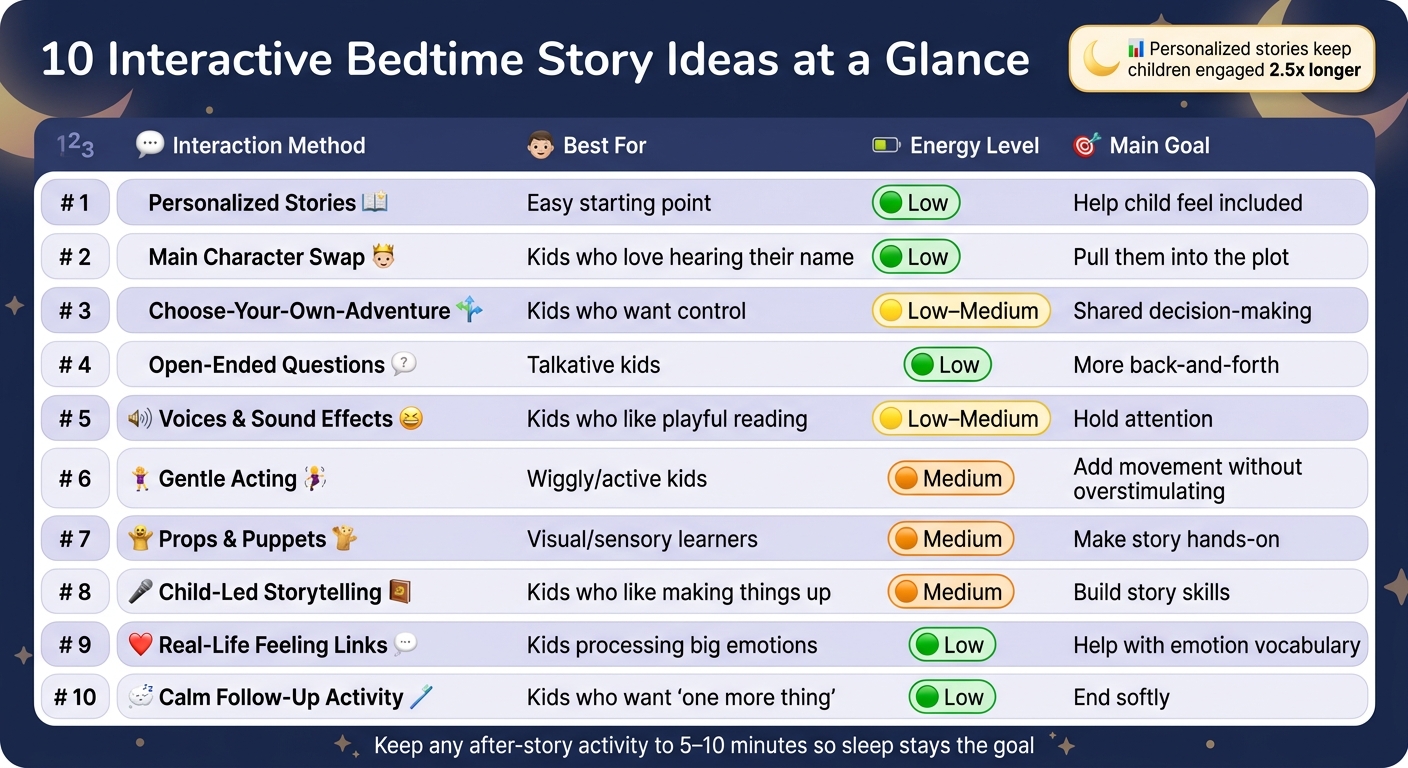
10 Interactive Bedtime Story Ideas: Energy Level & Best Use Guide
Not every idea fits every bedtime. A child who still has tons of energy needs something different from a sleepy toddler who just wants a soft, calm voice. This chart helps you match the story style to your child’s energy, not only their age.
| Interaction Method | Best For | Energy Level | Best Result |
|---|---|---|---|
| Kidooki Personalized Stories | Ages 2–7; a gentle screen-free start | Low - calming | Makes the child feel seen |
| Choose-Your-Own-Adventure | Toddlers who want control | Low to Moderate | High collaboration |
| Open-Ended Questions | Talkative kids | Low | Child feels heard |
| Props & Puppets | Visual and sensory learners; kids afraid of the dark | Moderate | Shared play and creative exploration |
| Acting Out Scenes | Active kids; kinesthetic learners | Moderate to High | Creates close, playful connection |
Personalized stories often keep a child’s attention longer because the story feels like it belongs to them. If you want the simplest place to start, go with one open-ended question and build from there. Aim for the calmest option that still holds their interest, then keep the pace slow so bedtime can ease in on its own.
How to Keep Storytime Interactive Without Disrupting Sleep
The goal isn't to stop being interactive. It's to dial the energy down as bedtime gets closer. Think of it like a slow fade, not a hard stop. You can still use the same tools - questions, voices, movement, and props - just in a way that's slower, softer, and shorter.
Start with the environment. Turn on warm, dim light before you open the book. Keep a stuffed animal nearby for your child to hold. That small touch helps them stay engaged without needing to wiggle, bounce, or move around much.
Once the room feels calm, let your reading match it. Gradually slow your reading pace and lower your voice. A lullaby-like rhythm can help your child settle, and a whisper can make a quiet moment feel special without adding extra buzz to the room. Interactive reading works best here as a calm back-and-forth, not a big performance.
If you want to bring in movement, keep it small and slow - a gentle stretch, a tiny hand motion, or a quiet point to the page. One reflective question, such as "How do you think the character felt?" can hold your child's attention while helping their body wind down.
As you get close to the end of the story, cut back on choices and keep the ending the same each night. Limit choices as the night gets later. Two calm book options are usually enough. Your child still gets a sense of control, but without too much stimulation. And when the story ends, a simple transition phrase like "Story time is done. Time for dream time" creates a gentle, steady boundary. When your energy is low, Kidooki's narration and calming illustrations can help keep storytime on track while you focus on snuggling.
Conclusion
Interactive bedtime stories don't have to feel like a whole production. Personalized stories and expressive reading can each increase engagement. What matters most isn't doing every little thing. It's making the moment feel shared.
The idea here is simple: connection matters more than perfection. Maybe you add your child's name to the story. Maybe you pause and ask what happens next. Maybe you let them act out one small scene. Those little choices can mean a lot.
Interactive reading works because it creates back-and-forth between parent and child. So start small tonight. Try one or two ideas and see how your child responds. And on nights when you're running low on energy, Kidooki's personalized stories and calming narration can help keep bedtime gentle while you stay present.
The best bedtime story is the one that leaves your child feeling seen, safe, and ready for tomorrow night.
FAQs
How can I keep bedtime stories interactive without making my child too excited?
Keep bedtime stories interactive, but keep the mood calm. Use a steady, gentle voice, set up soft lighting, and turn off screens that might pull your child out of the moment.
You can also ask simple, open-ended questions that invite quiet reflection instead of big, high-energy reactions. For example:
- “What part of the story made you feel peaceful?”
- “Which character would you like to dream about tonight?”
- “What do you think happens next?”
Kidooki fits this style well with personalized stories, calming illustrations, and professional narration that helps make bedtime feel more soothing.
What if my child doesn’t want to answer questions during storytime?
Don’t force it. The point is to make reading feel good, not like a quiz. If your child doesn’t want to answer, just keep reading and let the story move along.
You can always try again another night. Or switch things up with puppets, sound effects, or a little role-play to keep them into the story without putting them on the spot.
Which interactive bedtime story idea is best for toddlers?
Acting out characters is a fun, hands-on activity for toddlers. You can mimic facial expressions or simple actions from the story, like making munching sounds or blinking like a star.
Kidooki can make story time even more engaging with personalized bedtime stories that include your child’s name and interests, plus professional narration and calming illustrations.