
Moral lessons in classic kids' stories: guide
If you want classic kids’ stories to stick, keep it simple: pick one clear lesson, match the story to your child’s age, ask one gentle question, and end bedtime in a calm way.
I’d sum up the whole guide like this: for ages 3 to 6, classic stories work best when they teach one main idea - like honesty, kindness, perseverance, or responsibility. After reading, I’d keep the follow-up short, warm, and easy. Then I’d use calm audio to help the lesson settle before sleep.
Here’s the full takeaway in plain English:
- I’d use stories with short plots and clear cause-and-effect
- I’d match the story to my child’s age and attention span
- I’d focus on 4 main lessons:
- honesty
- kindness
- perseverance
- responsibility
- I’d ask one simple question after reading
- I’d connect the story to one small moment from my child’s day
- I’d skip stories that feel too scary, too long, or too busy
- I’d choose bedtime audio with a slow voice, steady pace, and calm ending
A quick fact worth noting: children ages 3–6 are still learning how feelings, choices, and results connect. That’s why short stories with one clear outcome tend to work better than long stories with many moving parts. In most cases, less talk works better than a long lesson.
| Focus area | What I’d do |
|---|---|
| Moral theme | Pick one clear lesson |
| Age fit | Choose short, easy-to-follow stories |
| After-reading talk | Ask one question about feelings or choices |
| Bedtime routine | Add calm audio after the book |
If I were using this guide tonight, I’d keep the goal simple: one short story, one short talk, and one quiet close to the day.
15 Classic Aesop’s Fables | Timeless Moral Stories for Kids | Little Fox
sbb-itb-d6d0693
Common moral themes in classic children's stories
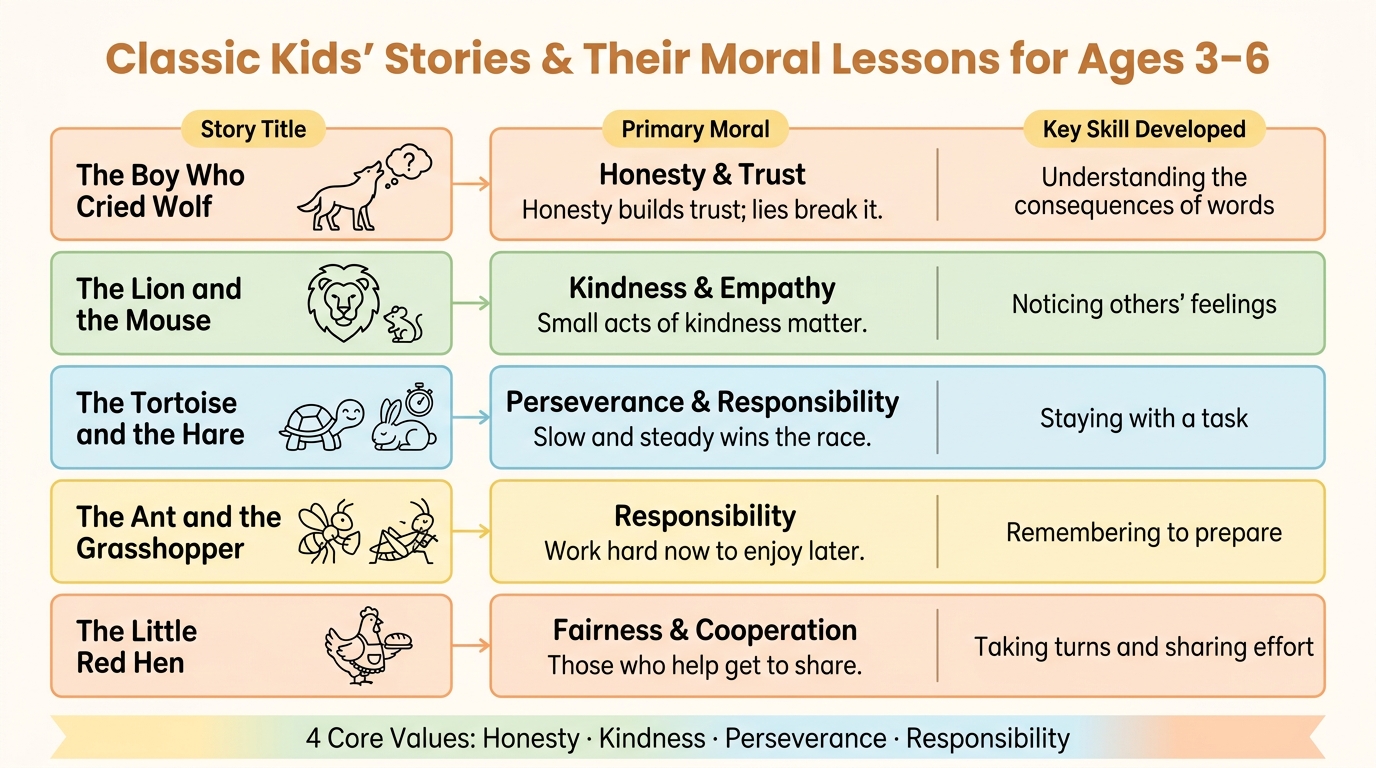
Classic Kids' Stories & Their Moral Lessons for Ages 3–6
Classic children's stories tend to come back to the same four values: honesty, kindness, perseverance, and responsibility. In preschool life, those ideas show up in simple, everyday ways - telling the truth, helping others, waiting for a turn, and sticking to routines.
Honesty, trust, and consequences
The Boy Who Cried Wolf shows a simple but big lesson: when someone lies, people stop trusting them. And once that trust is gone, even honest warnings can be hard to believe.
Kindness, empathy, and helping others
The Lion and the Mouse shows that even small acts of kindness matter. It also helps children notice how other people feel. A small act of help can go a long way.
Patience, perseverance, and responsibility
The Tortoise and the Hare and The Ant and the Grasshopper connect these ideas to daily routines. They show why patience, perseverance, and responsibility matter when children finish tasks, wait for turns, and get ready ahead of time.
Some stories also teach kids how to work with other people, not just how to finish something on their own.
Fairness, cooperation, and taking turns
Stories built around shared goals help children see how fairness, cooperation, and turn-taking support a group. The Little Red Hen makes that point especially well.
Here’s a quick guide to the clearest preschool matches:
| Classic Story | Primary Moral | Skill |
|---|---|---|
| The Boy Who Cried Wolf | Honesty and trust | Understanding the consequences of words |
| The Lion and the Mouse | Kindness and empathy | Noticing others' feelings |
| The Tortoise and the Hare | Perseverance and responsibility | Staying with a task |
| The Ant and the Grasshopper | Responsibility | Remembering to prepare |
| The Little Red Hen | Fairness and cooperation | Taking turns and sharing effort |
Next, match these themes to your child's age and attention span.
How to choose age-appropriate moral stories for preschoolers
Once you know the main moral, the next step is matching the story to your child’s age and attention span. The goal is simple: pick a story your child can follow, feel, and remember. For ages 3 to 6, that usually means stories that are short, clear, and easy to revisit.
Best fit for ages 3 to 4
At this age, simpler is better. Choose stories with one clear action, repeated language, and an easy-to-see result. Preschoolers this young tend to follow feelings more than plot, so the lesson should show up in what a character does and what happens right after.
Bedtime is a good test. If your child can follow the story without much help, that’s a strong sign it’s worth reading again.
Best fit for ages 5 to 6
For ages 5 to 6, you can go a little further. Stories with a slightly longer plot work well, as long as the main character makes one clear choice and the moral is something your child can say out loud.
At this stage, children can keep a short chain of events in mind. They also start linking a character’s choice to what happens next. A brief story like Stone Soup fits nicely here, since cooperation leads to a shared reward.
When to simplify or skip a classic story
Some classics just ask too much from a preschooler. If a story has scary scenes, too many characters, or more than one lesson fighting for attention, it’s often better to skip it.
The same goes for stories that need a lot of setup before they make sense. If you have to pause and explain everything, it’s probably too much for a calm bedtime read. In that case, a simpler retelling or a different title usually works better.
Signs a story is a good preschool match
A good preschool story usually has four clear signs:
- Short length
- One cause-and-effect moment
- Feelings your child already knows
- A calm ending
If a story checks those four boxes, it’s a good bedtime pick. After choosing the right story, the next step is talking about it in a way your child can use.
How to talk about the moral lesson after reading
Once you have a story your child can follow, the next step is a short talk that helps the lesson stay with them. After the story, keep it simple. Name the lesson in plain words, link it to one feeling or one choice, and talk about it without any pressure.
The point isn't to quiz your child. It's to help them notice what the character felt, what they chose, and what they learned. At bedtime, less is more. The best chats are brief, warm, and easy to let go of before sleep. One question is enough to get started.
Ask simple questions about feelings and choices
Start with easy questions your child can answer without overthinking. Focus on how the character felt or what they decided to do.
You might ask:
- "How do you think the character felt?"
- "What choice did they make?"
- "Was that a kind choice?"
- "What did they learn?"
These kinds of questions keep the talk light while still helping your child think a little deeper.
Connect the story to moments in your child's day
A story lands better when your child can link it to something from their own life. That connection doesn't need to be big. Small moments work best.
For example, if the story is about sharing, you might say, "That reminds me of when you shared your crayons today." If it's about telling the truth, you could point to a moment when they admitted a mistake. Now the lesson isn't just in the book. It feels close and familiar.
Keep the conversation brief, warm, and non-lecturing
This part matters more than most parents think. If the talk starts to feel like a lesson about your child, they may shut down fast. A calm, gentle tone works better.
You don't need a long speech. A sentence or two, plus one question, is often plenty. Bedtime is not the moment for a heavy talk. Keep it warm, keep it easy, and let the story do most of the work.
Use play, drawing, or retelling when talking feels hard
Some kids don't want to talk much, especially at the end of the day. That's normal. If words feel hard, let them show what they understood in another way.
They might draw their favorite part, act out the story with toys, or retell it in their own words. Sometimes a child says more through play than through direct conversation. And honestly, that's fine. The goal is still the same: help them notice the feeling, the choice, and the lesson.
How to pair classic stories with calm audio storytelling at bedtime
After the short moral talk, use calm audio to stretch the lesson and help your child drift toward sleep. Once the story chat ends, audio can keep the idea in place without making your child more alert. A short read-aloud, a brief reflection, and a calm audio story can work as one bedtime rhythm. That matters because classic stories often land best when kids have a quiet moment to sit with them.
A simple bedtime flow that supports reflection and sleep
Start with one short classic story. Then pause for a minute and talk about the lesson with a simple question or a small personal connection. After that, switch to audio with a calm voice and an even pace.
For bedtime, pick audio that feels gentle and familiar. Slow narration and a reassuring ending can help your child settle with less friction.
Why personalized audio can reinforce gentle lessons
Personalized narration can make the calm part of bedtime feel more familiar and easier to remember. When a child hears their own name or a favorite interest woven into a gentle story, the lesson can stick a little more naturally.
Kidooki offers personalized bedtime stories with a child's name, interests, and professional narration.
How to keep audio calming instead of stimulating
Not every audio story fits bedtime. If you want the wind-down period to stay soothing, look for slow narration, gentle sound design, and a steady pace. A predictable, reassuring ending also helps a child feel safe before sleep.
Use the format below to choose audio that supports sleep, not stimulation.
| Bedtime approach | Engagement | Routine ease | Reinforces the lesson |
|---|---|---|---|
| Read-aloud only | High during reading, then fades | Simple, but may not extend the lesson | Moderate - depends on discussion |
| Read-aloud, then standard audio | Moderate | Easy to add | Moderate - depends on how well the story fits the lesson |
| Read-aloud, then personalized audio | High | Smooth transition to sleep | Strong - familiar names and interests reinforce the lesson |
Keep the audio slow, familiar, and quiet. At bedtime, it should carry the lesson softly, not replace it.
Conclusion: the simplest way to make classic morals meaningful
Classic stories tend to work best when the lesson is clear and the follow-up is short. Once you've picked a story, matched it to your child's age, and had a brief chat about the lesson, the last step is simple: keep bedtime calm.
Stick with one clear theme, choose a story that fits your child's stage, and end with one gentle question. That's often enough. You don't need to turn bedtime into a lecture.
At that point, the night shifts from teaching to winding down. A personalized story with professional narration can help close the evening on a soft, comforting note. That quiet ending gives the lesson room to settle without more talk. Kidooki offers personalized bedtime stories with a child's name, interests, and professional narration.
One short classic story, one gentle question, and one calm story to close the night.
FAQs
What if my child misses the moral?
Don’t worry - kids usually learn from stories bit by bit, not all at once. The best approach is often simple: ask open-ended questions about a character’s choices or how a moment might have made them feel.
If it fits, personalized stories through Kidooki can help your child feel closer to the story itself. That connection can make the main ideas easier to grasp. Over time, calm, repeated conversations let those lessons sink in without pressure.
Can I use classic stories outside bedtime?
Yes. Classic stories can fit into plenty of moments beyond bedtime, like quiet play, car rides, or a calm wind-down after school. They can help kids pick up moral lessons and grow their vocabulary at the same time.
You can also pair them with calm audio storytelling to help kids listen with more focus during the day. Kidooki offers personalized, professionally narrated stories you can use anytime.
How often should we repeat the same story?
Repetition plays a big role in how children learn. When they hear the same story again and again, they start to absorb the lesson, pick up on how stories are built, and feel more at ease with something familiar.
There isn’t a hard limit here. The best approach is to follow your child’s lead. With Kidooki, you can save favorite stories and bring them back anytime your child wants a calm, personal bedtime story.