7 Benefits of Reading to Your Child Every Night
Reading to your child every night is one of the simplest ways to support their growth and create lasting memories. It’s not just about bedtime stories - it’s about building skills, strengthening bonds, and nurturing a love for learning. Research shows that kids who are read to daily hear hundreds of thousands more words by kindergarten, boosting their language and cognitive abilities. Despite its importance, fewer parents are engaging in this routine today, but starting now can make a big difference.
Here’s why bedtime reading matters:
- Boosts language skills: Books introduce new words and sentence structures, expanding your child’s vocabulary.
- Encourages critical thinking: Stories teach cause-and-effect, problem-solving, and creativity.
- Improves sleep: A consistent reading routine helps kids relax and sleep better.
- Strengthens bonds: Shared reading time fosters emotional closeness and trust.
- Builds lifelong habits: Kids associate reading with comfort and enjoyment, encouraging a love for books.
- Enhances focus and memory: Following stories improves attention span and memory retention.
- Reduces stress: Reading creates a calming, safe space for kids to unwind.
Even just 5–20 minutes a night can have a lasting impact. Start small, let your child pick their favorite book, and make bedtime reading a cherished tradition.
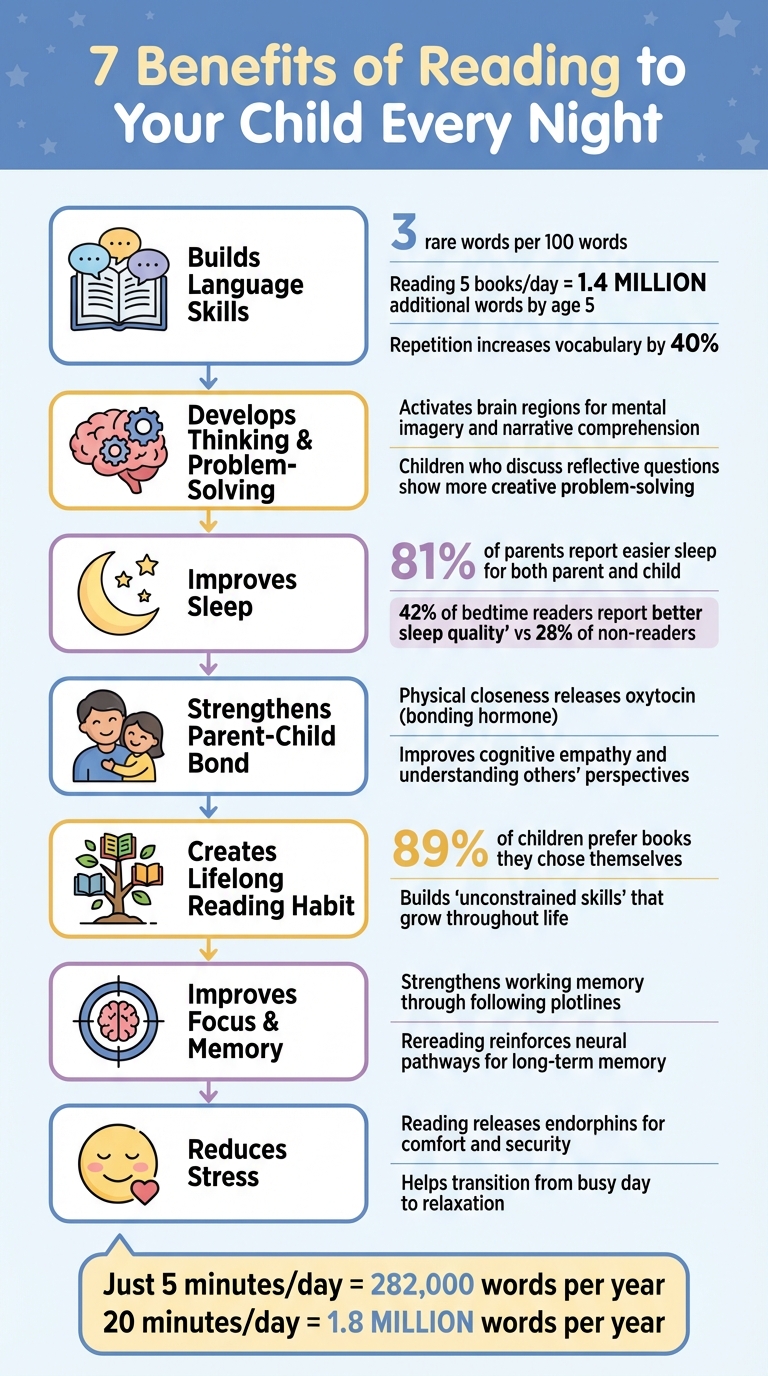
7 Benefits of Reading to Your Child Every Night: Key Statistics
Why Should You Read to Your Child?
sbb-itb-d6d0693
1. Builds Language Skills and Expands Vocabulary
Everyday conversations stick to familiar words, but books open the door to a whole new world of language. They introduce unique vocabulary, complex sentence structures, and grammar patterns that you don’t often hear in daily chats. On average, books include 3 rare words for every 100 words. This kind of exposure helps develop essential language pathways in the brain, forming a strong base for reading, writing, and communication skills.
Here’s a mind-blowing fact: reading just five books a day can expose a child to around 1.4 million additional words by the time they turn 5. That early exposure plays a key role in building the neural connections needed for language development.
"Just exposure to words is the single most important thing that you can do to help build the language pathways in your child's brain." – Laura Phillips, PsyD, Neuropsychologist
When you read aloud, you’re doing more than just telling a story - you’re modeling fluent and expressive speech. By emphasizing certain words, pausing for dramatic effect, or using different voices for characters, you’re teaching your child how language flows and how sentences come alive. They start to grasp the rhythm of language, understand how to stress important words, and see reading as an engaging, dynamic activity. This naturally builds on the vocabulary foundation created by word exposure.
Repetition takes these skills even further. Reading the same book multiple times can increase a child’s vocabulary by up to 40%. Each rereading helps them pick up new words, recognize familiar patterns, and grow more confident in their language abilities. And the best part? These benefits hold true no matter which language you’re reading in.
2. Develops Thinking and Problem-Solving Abilities
Stories are more than just entertainment - they're tools that help children learn how to think critically and solve problems. When kids follow a story from the beginning to the end, they start to recognize cause-and-effect relationships and see how actions lead to consequences. For example, when a character encounters a challenge, a child's mind is naturally working to predict what might happen next. This process lays the groundwork for analytical thinking.
"As children listen to what happens first, next, and last, they build critical thinking skills. They learn to predict what might happen, understand cause and effect, and follow complex plots." – Natalie Turner, Author, Wonder Wraps
Reading also activates parts of the brain tied to mental imagery. When children visualize characters, settings, and events, they're actively processing information. A 2015 study in Pediatrics showed that reading during preschool years stimulates brain regions involved in mental imagery and narrative comprehension. This mental exercise strengthens their overall ability to think and understand. On top of that, asking kids questions while reading can deepen their engagement and encourage creative thinking.
Taking a moment to ask reflective questions like, "What would you do?" or "How could they solve this problem?" sparks imaginative problem-solving. A 2026 study involving 38 families with children aged 6 to 8 revealed that those who paused to discuss reflective questions during storytime came up with more creative solutions in problem-solving tests compared to families who read straight through.
"It is the talk that surrounds the reading that gives it power, helping children to bridge what is in the story and their own lives." – International Reading Association (IRA) / National Association for the Education of Young Children (NAEYC)
Books offer a kind of safe practice ground where kids can observe characters tackling problems and exploring different outcomes. These experiences help them build practical problem-solving skills they can use at school and in everyday life.
3. Helps Children Fall Asleep Faster and Sleep Better
Bedtime stories do more than nurture language and thinking skills - they’re a fantastic way to improve sleep. A consistent reading routine signals your child that it’s time to wind down. When you read at the same time every night, it creates a predictable pattern, helping the brain shift from activity to rest. Essentially, this routine acts as a sleep cue, triggering a relaxation response in the body.
"Bedtime reading actually triggers and enhances the sleepiness and relaxation because of that association. With repetition, bedtime reading becomes a very powerful sleep cue." – Janet Krone Kennedy, Ph.D., Clinical Psychologist
Reading aloud also helps calm the body by slowing the heart rate and easing muscle tension built up during the day. Unlike screens, which emit blue light that can interfere with melatonin production, books are a natural way to encourage sleepiness. In fact, 81% of parents say that reading to their children helps both them and their kids fall asleep more easily.
The type of story you choose matters, too. Books with rhythmic patterns or familiar themes can help reduce mental stimulation, while rereading favorite stories provides comfort and predictability, making it easier for children to relax.
Research supports this idea, showing that a regular bedtime story routine can lead to longer and more restful sleep for preschoolers. Behavioral Sleep Medicine Psychologist Jade Wu highlights this benefit:
"There is research showing that in preschoolers, a bedtime story may help them to sleep longer and better."
To make the routine even more effective, consider adding dim, warm lighting and a few calming pre-bedtime activities, like putting on pajamas and brushing teeth, to create a smooth transition to sleep.
4. Strengthens the Parent-Child Bond
Bedtime reading offers a rare treasure in today’s fast-paced world: uninterrupted, one-on-one time where parents and children can truly connect. This quiet ritual not only fosters emotional security but also supports cognitive growth.
The physical closeness of reading together deepens the bond. When you cuddle up with a book, your child isn’t just hearing a story - they’re also benefiting from the comforting touch that releases oxytocin, often called the "bonding hormone". Dr. Laura Phillips, a neuropsychologist at the Child Mind Institute, explains:
"The physical contact that you get from being held by your parent while you're reading actually helps to engage neurons in the brain, which make kids more receptive to both language and cognitive stimulation."
Books naturally encourage meaningful conversations about emotions and challenges, building trust and a sense of security. For instance, asking questions like, "How do you think this character feels?" can lead to deeper insights into your child’s thoughts and emotions. In fact, research from 2026 highlights that children whose parents read to them regularly show marked improvements in cognitive empathy and understanding others’ perspectives. Establishing this routine creates a safe space where children feel comfortable sharing their feelings. Dr. Leora Mogilner, Associate Professor of Pediatrics at the Icahn School of Medicine at Mount Sinai, emphasizes:
"The cuddling and snuggling that take place with bedtime reading promote parent-child bonding and lets children know that they are loved and cared for."
Letting your child pick the book - even if it’s the same one every night - can make the experience more enjoyable for them. Use playful voices and ask open-ended questions to keep the interaction engaging. And as your child grows, continuing this tradition ensures that this special connection remains strong.
5. Creates a Lifelong Reading Habit
Reading to your child every night does more than just entertain - it builds a powerful emotional bond between books and feelings of comfort and love. This connection turns reading into something your child will naturally enjoy and seek out, rather than seeing it as just another chore.
The benefits of this habit show up early. Educators often talk about "unconstrained skills", like vocabulary and comprehension, which are abilities that keep growing throughout life. These skills aren't limited to childhood; they continue to expand as your child matures.
Behavioral Sleep Medicine Psychologist Jade Wu explains how reading can also shape bedtime routines:
"In general, having quiet independent reading time is a great bedtime routine to take into adolescence and adulthood because this can be a lifelong cue for the body and brain to transition from a busy day to relaxation and sleepiness."
Letting your child choose their own books can further strengthen their love for reading. In fact, research shows that 89% of children say their favorite books are the ones they picked out themselves. Even after your child becomes an independent reader, continuing to read together helps maintain their enthusiasm for books and reinforces their literacy skills.
Children often imitate what they see. When they watch you enjoying a physical book, it encourages them to do the same. Combine this modeling with a consistent nightly reading routine, and you'll set the stage for a lifelong habit. Over time, your child will reach for books naturally - whether to learn something new, unwind, or simply enjoy a story. Plus, this habit supports better focus and memory as they grow.
6. Improves Focus and Memory
Building on the cognitive and language skills gained earlier, bedtime reading also sharpens focus and enhances memory. By engaging in a story, children train their brains to concentrate on one task at a time. This practice of active listening is essential for success in school and everyday activities. Healthline notes, "Children who are read to consistently learn to become active listeners, who sit still, fostering a longer attention span while also working on their memory retention skills". This ability to focus directly supports better memory retention.
Following characters and plotlines in a story strengthens working memory, which is crucial for tasks like solving math problems or following multi-step instructions. Studies reveal that reading during the preschool years activates brain regions tied to mental imagery and understanding narratives.
Interactive moments, like asking questions such as "What happens next?" or encouraging predictions, further enhance focus and critical thinking. These activities challenge kids to recall details and engage more deeply with the story.
Rereading favorite books plays a key role in memory development. Knowing the plot allows children to focus on specific elements like vocabulary, rhymes, or text patterns. This repetition reinforces neural pathways, supporting long-term memory.
Dr. Laura Phillips, a neuropsychologist, highlights the broader benefits:
"Reading and exposure to words helps kids maximize their language and cognitive capacity".
The physical closeness during storytime also contributes. Being held while listening activates neurons that enhance cognitive receptivity, creating an ideal setting for learning and memory building.
7. Reduces Stress and Helps Children Relax
After a long, busy day, kids often need help shifting from high energy to a restful state. Bedtime reading serves as a soothing ritual that helps young minds transition to sleep. Dr. Leah Alexander, a pediatrician, highlights this benefit:
"Reading at bedtime is a great way for children and teens to 'wind down' before sleep and give their brains a rest after a day of learning and socializing".
Snuggling up with a book releases endorphins, fostering feelings of comfort and security. This sense of emotional safety provides kids with a protected space to process their day’s ups and downs.
The effects of this calming routine are tangible. For instance, 81% of parents say that reading to their children helps both the parent and child fall asleep. Similarly, 42% of people who read before bed report better sleep quality, compared to just 28% of non-readers. Stories also give children a chance to explore emotions alongside fictional characters, helping them understand and manage their own feelings.
To make the most of this routine, stick to physical books instead of screens. Devices like tablets and e-readers emit blue light, which can interfere with melatonin production - the hormone that regulates sleep . Even reading just a few pages can help set the stage for relaxation. Behavioral Sleep Medicine Psychologist Jade Wu explains:
"Having quiet independent reading time is a great bedtime routine... because this can be a lifelong cue for the body and brain to transition from a busy day to relaxation and sleepiness".
How to Start a Bedtime Reading Routine
Bedtime reading is more than just a relaxing end to the day - it’s a chance to strengthen bonds and build language skills, even for newborns. Dr. Leora Mogilner, Associate Professor of Pediatrics at the Icahn School of Medicine at Mount Sinai, highlights this beautifully: "Establishing a bedtime routine that includes reading books and telling stories is a wonderful way to promote parent-child bonding while helping develop children's literacy, language, and social-emotional skills". Even before babies can understand words, hearing your voice and feeling your closeness makes a big difference.
Start by creating a cozy and inviting reading space. A comfortable chair or a spot on the bed, soft lighting, and a small bookshelf within reach can make the experience enjoyable. To help your child wind down, avoid screens for at least an hour before bedtime - blue light can interfere with sleep. Let your child choose the book, even if they pick the same one again and again. Familiar stories often become “reassuring narratives,” offering emotional comfort and a sense of routine.
Stick to the routine - it doesn’t take much time to make a big impact. Reading for just 5 minutes a day adds up to 282,000 words a year, while 20 minutes can expose your child to 1.8 million words. Even on busy nights, a few pages matter. For younger kids, use animated voices, point to pictures, and ask simple questions to keep them engaged. With school-age children, try taking turns reading or let them read independently, then chat briefly about the story.
Choose books that match your child’s age and interests. For newborns to 1-year-olds, sturdy board books with bold, high-contrast images work well. Toddlers aged 1 to 3 enjoy rhyming books and repetitive “goodnight” stories. Preschoolers aged 3 to 5 thrive on ABC and counting books with fun, story-driven narratives. Older kids can dive into chapter books or non-fiction that challenges their growing comprehension. Picking the right books ensures your child stays engaged and looks forward to this special time.
Add a personal touch with tools like Kidooki, which creates custom bedtime stories tailored to your child’s name and interests. These professionally narrated stories, paired with calming illustrations, keep the routine fresh while maintaining the comforting structure children love. You can even save favorite stories in a library and set up profiles for multiple kids, making it easy to stick to the habit - even on hectic nights.
Conclusion
Reading to your child every night is a simple habit with a powerful impact on their future. This guide has highlighted how nightly reading not only enhances your child's skills but also deepens your bond. Every story shared at bedtime contributes to their growth in ways that extend far beyond those quiet moments. As Carl Sagan wisely said, "One of the greatest gifts adults can give – to their offspring and to their society – is to read to children".
Even a few minutes each night can leave a lasting impression. Spending just 20 minutes a day reading together helps improve fluency, build vocabulary, and develop stronger comprehension skills. These short, consistent sessions are the foundation of a lifelong love for reading.
Focus on connection, not perfection. Dr. Peter Gorski, chair of the early childhood committee of the American Academy of Pediatrics, emphasizes the importance of making reading an enjoyable experience: "To best confer reading's cognitive benefits, a child's experiences with books should be enjoyable. More than anything, you want him to associate reading with emotional warmth and fun". Whether you're diving into a new story or revisiting an old favorite, the joy and closeness you create are what matter most.
Keep reading aloud, even after your child learns to read on their own. Research shows that over 33% of children aged 6–11 wish their bedtime reading rituals would continue. This shared time remains meaningful, even as their reading skills grow.
Why wait? Start tonight and see the magic happen. With personalized bedtime stories, you can turn reading into a treasured family tradition. Your child's expanding mind, happy heart, and restful sleep will thank you for every story shared.
FAQs
What if my child won’t sit still for books?
If your child finds it hard to sit still for storytime, there are a few things you can try. Start by setting up a calm and cozy space - a comfy chair or a soft blanket can make a big difference. Use a gentle, slow tone when reading to help hold their attention, and keep the sessions short - 5 to 10 minutes is usually perfect for younger kids.
You can also make reading more engaging by using expressive voices or connecting the story to something they love. For example, if they’re into animals, pick a book about their favorite creatures. Above all, remember that patience and consistency will help make reading a positive experience over time.
Is it OK to read the same book every night?
Yes, reading the same book every night can be incredibly helpful for kids. Repetition allows them to build their vocabulary, notice patterns and rhythm in language, and boost their reading fluency. Plus, it establishes a comforting routine that promotes a sense of security and strengthens the bond between parent and child.
When should I stop reading aloud to my child?
You might think you should stop reading aloud once your child starts reading independently, but keeping it up can still play a big role in their social, emotional, and cognitive growth. Even older kids gain a lot from shared reading - it strengthens your bond and introduces them to richer language and more advanced ideas.