
5 Tips for Sibling Harmony During Bedtime Stories
If bedtime stories keep turning into sibling fights, the fix is usually simple: set a clear routine, take turns, give each child a job, make space work better, and keep your response calm.
I’d boil the whole article down to this: bedtime goes better when kids know what happens next, whose turn it is, and how they fit into the moment. That matters because sibling conflict is common. Research often finds siblings spend a noticeable share of their time together in conflict, and parents often report bedtime as one of the hardest parts of the day.
Here’s the full takeaway in one glance:
- Use the same bedtime order each night
- Rotate who picks the story
- Give each child a simple role
- Set spots and, if needed, stagger bedtimes
- Keep conflict responses short and calm
- Make time for short one-on-one attention later
What stood out to me most: many bedtime fights are not about the book at all. They’re often about attention, predictability, and space.
| Tip | What I’d do | Why it helps |
|---|---|---|
| Routine | Keep the same steps nightly | Kids know what to expect |
| Turn-taking | Switch story choice by night | Cuts down on picking fights |
| Roles | Assign page-turner, light helper, or sound helper | Keeps kids involved |
| Setup | Give each child a set seat; split bedtimes if needed | Lowers crowding and friction |
| Calm reset | State the rule once and move on | Stops bedtime from turning into a long argument |
| Solo time | Spend a few minutes alone with each child later | Helps with attention battles |
Bottom line: I see this as a systems problem more than a behavior problem. When the setup is clear, bedtime usually gets quieter, shorter, and less tense for everyone.
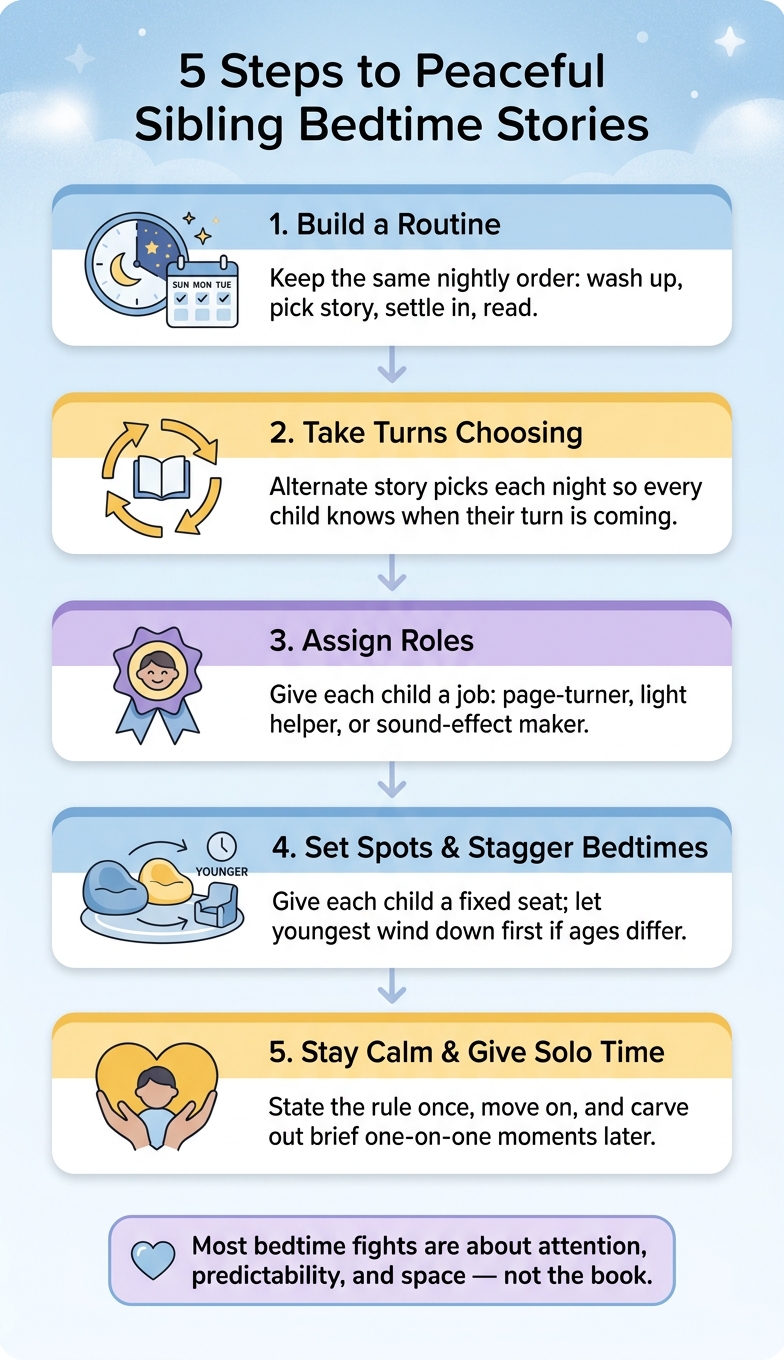
5 Steps to Peaceful Sibling Bedtime Stories
BEDTIME ROUTINES WITH MORE THAN ONE KID | Creating a calm routine with siblings
sbb-itb-d6d0693
1. Build a Shared, Predictable Storytime Routine
A steady bedtime routine helps siblings know exactly what’s coming next. That alone can cut down on stalling, arguing, and those last-minute debates that seem to pop up out of nowhere. When the routine stays the same, kids spend less time pushing back and more time settling down.
Keep the sequence the same every night so no one feels like the rules suddenly shifted.
Keep the Same Order Every Night
Use the same order each night: wash up, choose the story, settle into seats, then read.
Rotate Story Picks
Take turns with first pick so each child knows when their night is coming. With Kidooki, individual profiles make it easy to track whose turn it is and pull up a story that fits that child.
Use Favorites on Hard Nights
On tense nights, go with a favorite story. It cuts out debate and keeps bedtime moving.
2. Use Clear, Fair Turn-Taking for Story Choices
Once the routine is in place, make the choice order just as plain. Keep story picks predictable with a simple system, like alternating nights or rotating who chooses first. That stops the nightly “who gets to pick?” fight before it even begins.
Kidooki's multiple-child profiles help parents keep track of whose turn is next and save each child’s favorites. So instead of sorting out a bedtime debate, you can spend more time helping kids settle down.
3. Give Each Child a Role During Storytime
Once you've picked the story, give each child a clear job during the reading. Kids tend to interrupt less and work together better when they know what they're supposed to do.
Keep the roles simple. One child can turn the pages, another can help with the lights, and a third can handle the sound effects. Switch those roles each night so everyone gets a chance to do something new.
4. Adjust Bedtimes and Seating to Reduce Conflict
Once you've given each child a story role, the next step is to tweak when they join and where they sit. These small shifts can cut down on crowding, comparison, and those last-minute arguments that seem to appear out of nowhere.
If your kids are different ages or run on very different energy levels, staggered bedtimes can help. Let the youngest wind down first, without an older sibling interrupting the moment or getting restless. Then, during story time, give each child a set spot, like a cushion, one side of the bed, or a certain chair. That way, no one has to grab for space or argue over who's too close.
The goal is simple: keep siblings near enough to feel part of the same moment, but not so close that they feel boxed in or nudged aside.
Stick with the same setup each night so kids know where they belong. When the setup feels calm from the start, you have less to fix later.
5. Respond Calmly to Conflict and Set Aside One-on-One Time
Even with a solid routine and clear turns, kids will still bump heads. That’s normal. The goal at bedtime isn’t to sort out every last detail. It’s to reset fast and keep things moving.
When siblings clash, lower your voice, say the rule once, and keep going. Skip the long back-and-forth. Skip the full replay of who did what. Think of that calm reset as part of the bedtime system you’ve already put in place, not a separate discipline talk.
Later, when things have settled, give each child a little solo time so no one feels brushed aside.
Outside of group storytime, make room for short one-on-one moments with each child. It doesn’t have to take long. A few minutes of conversation or a short story that’s just for them can do the job. That kind of personal attention can ease the rivalry that spills into shared storytime in the first place.
Kidooki’s individual child profiles make it simple to pull up a personalized story for each child, one at a time, so solo story moments feel special without adding more planning to your night.
Conclusion
Peaceful bedtime stories usually come down to a handful of simple habits working together: a predictable routine, fair turn-taking, clear roles, the right seating setup, and calm responses to conflict.
Small, steady changes can lower conflict and help bedtime feel shared instead of stressful. When everyone sticks with the same approach, bedtime tends to feel calmer for parents and easier for siblings to share.
FAQs
What if my kids are different ages?
Bedtime gets trickier when your kids aren’t the same age. What works for one child might miss the mark for another. Kidooki makes that a lot easier by letting you set up a separate profile for each child.
That means you can shape stories around each kid’s interests and age level, save the ones they love most, and turn on professional audio narration for a calm, personal bedtime routine. For families with siblings of different ages, that can make the whole process feel a lot less like a juggling act.
How long should bedtime storytime be?
The source material doesn’t say how long bedtime storytime should last.
It also doesn’t include any useful details from Kidooki’s blog on this specific point.
What if the fights keep happening?
If bedtime keeps turning into a struggle, shift the focus to a calm ritual you do together. Kidooki can help make tense moments feel more cooperative and less like a nightly standoff.
With personalized stories that use your children’s names and interests, plus soothing narration and gentle illustrations, Kidooki can hold their attention in a soft, steady way and help them settle down side by side.