Personalized Bedtime Stories: Parent Guide
A personalized bedtime story can make bedtime smoother by doing four simple things: use familiar details, fit your child’s age, stay calm, and follow the same routine each night.
If I were helping a parent fast, I’d say this: keep stories to 3–5 minutes for ages 3–4 and 5–10 minutes for ages 5–6, use only 1–3 known details like a child’s name or favorite toy, and end with a quiet image instead of a surprise. That matters because many young kids do better at bedtime when the routine feels known and the story does not add extra energy.
Here’s the whole idea in a few bullets:
- Use familiar details: name, nickname, pronouns, bedtime steps, pet, sibling, or favorite toy
- Match the age: simpler and shorter for ages 3–4; a bit longer with a small goal for ages 5–6
- Keep the tone calm: short sentences, soft images, early problem-solving, peaceful ending
- Avoid bedtime triggers: scary parts, loud scenes, cliffhangers, and silly bits that wind kids up
- Pick a steady format: parent read-aloud, audio, or both
- Keep screens off before bed: the article suggests 30–60 minutes with no screens before bedtime
- Limit audio length: about 10–20 minutes for ages 3–6
A quick way I’d think about it is this: a good bedtime story should feel a lot like the bedtime routine itself - familiar, slow, and easy to follow. The goal is not a big plot. The goal is a child who feels safe, calm, and ready to sleep.
Gabby’s Bedtime Book - Personalized Children's Books - First Time Books
sbb-itb-d6d0693
Quick comparison
| Topic | Ages 3–4 | Ages 5–6 |
|---|---|---|
| Story length | 3–5 minutes | 5–10 minutes |
| Characters | 1–2 | 2–3 |
| Plot | One small problem | One simple goal in 2–3 steps |
| Tone | Very gentle | Gentle with a small feeling or choice |
| Best ending | Quiet and still | Clear and comforting |
So if I had to sum up the article in one line, it would be this: the best personalized bedtime stories are short, familiar, calm, and told the same way night after night.
Choose the personal details that make a story feel familiar
A personalized story doesn’t need a long list of details. It just needs a few that your child knows at once.
Start with name, age, pronouns, and bedtime routine steps
The details that work best are usually the simplest ones. Start with your child’s preferred first name or nickname, their age, and the pronouns they use. Then bring in parts of their actual bedtime routine - taking a bath, putting on pajamas, brushing teeth, switching on the night-light, or grabbing a favorite blanket.
Those familiar bedtime steps help the story feel calm, known, and easy to settle into.
Add family members, pets, favorite things, and current feelings
After that, add one or two extra details. A sibling’s name, the family dog, a favorite color, a beloved toy, or a place like home or preschool can make the story feel more personal.
You can also work in a gentle feeling your child is having right now - maybe they feel shy about something new, proud of a small win, or just plain sleepy. Keep it light. One or two extras per story is plenty.
Once you know which details matter most, save them in one place so they’re easy to use again.
Keep a simple story profile for each child
A short profile gives you an easy way to repeat the same calming story shape night after night. Kidooki lets parents save separate profiles for each child and keep favorite stories organized.
With the right details in place, the next step is matching story length and complexity to your child’s age.
Match story structure to ages 3 to 4 and 5 to 6
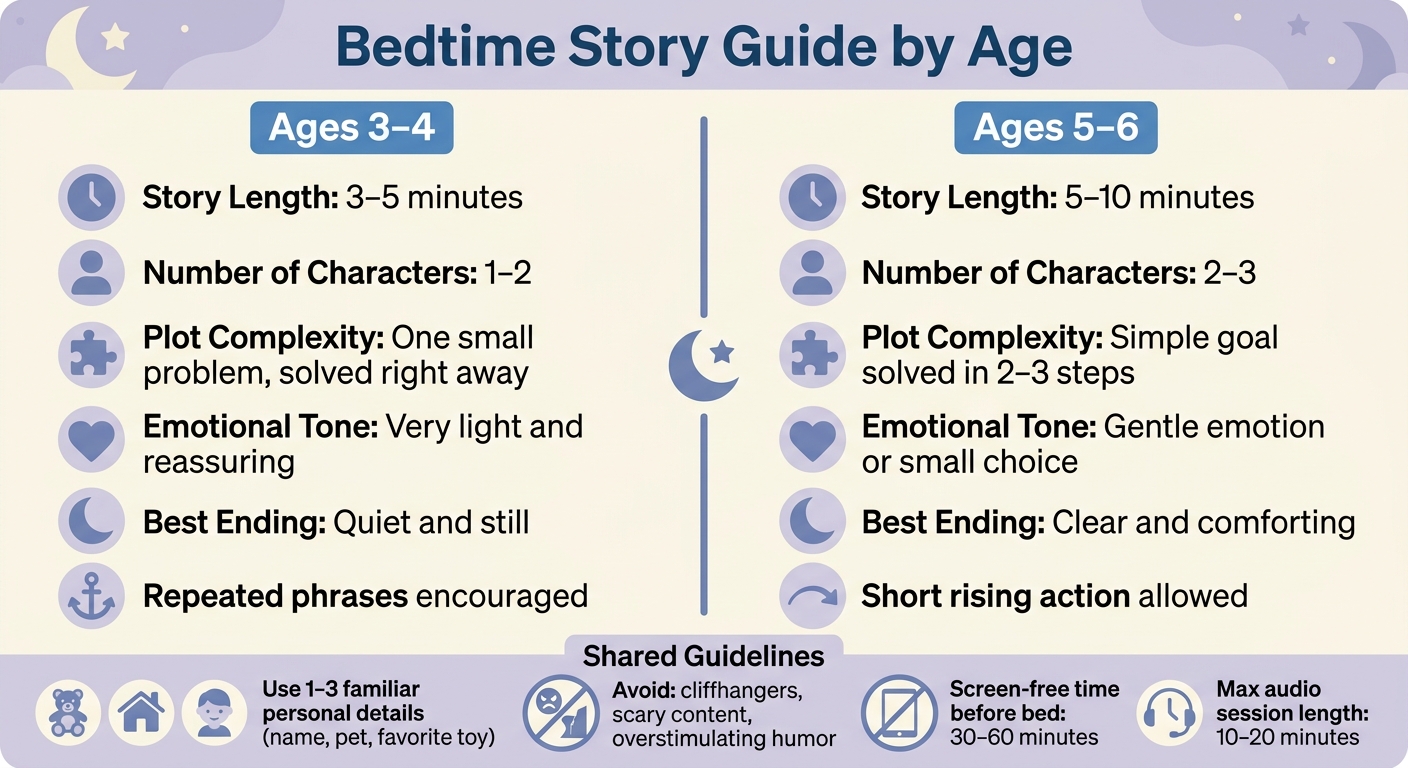
Bedtime Story Guide by Age: 3–4 vs. 5–6 Year Olds
Use the details in your story profile to line up the story’s length and plot with your child’s age. Kids ages 3 to 6 usually settle more easily when a story feels familiar, moves in a straight line, and ends in a clear way.
Ages 3 to 4: short stories, repetition, and one simple problem
For 3- and 4-year-olds, shorter is usually the safer bet. Aim for stories that last about 3 to 5 minutes. Keep it to one or two main characters and place them somewhere your child already knows, like home, daycare, or the playground.
Repeated phrases can work like a little anchor. They give young kids something to expect, which helps the story feel steady and easy to follow. The problem should stay small and be solved fast.
Ages 5 to 6: slightly longer plots with a simple goal
Five- and 6-year-olds can usually handle a little more story. A runtime of 5 to 10 minutes tends to work well. At this age, you can add two or three characters and give them a simple goal to work toward.
Let the problem play out in two or three easy steps before it gets solved. That gives the story a bit more shape without making it hard to follow. Keep the ending clear and comforting.
Age guide table: story details for ages 3 to 4 vs. 5 to 6
| Story element | Ages 3 to 4 | Ages 5 to 6 |
|---|---|---|
| Story length | 3–5 minutes | 5–10 minutes |
| Number of characters | 1–2 | 2–3 |
| Plot complexity | Single problem, solved right away | Simple goal solved in 2–3 steps |
| Emotional tone | Very light and reassuring | Gentle emotion or choice |
Once the structure fits their age, keep the language calm and predictable.
Keep the tone gentle, predictable, and ready for sleep
Once the story fits your child's age, the next step is keeping the tone calm. That matters because tone can shape how fast a child settles down and drifts off. Familiar details help your child ease into the story. Then the language needs to do its part too. It should guide them toward sleep, not pull them into more alertness or stir up extra energy.
Use short sentences, soft sensory images, and a clear ending. Phrases like "soft blanket," "dim light," and "quiet room" work well because they match the space your child is already in. Solve the story's problem early and in plain, reassuring language. Then let the story move into a quiet close. End on a still, peaceful image, not on action or a last-minute surprise.
Use calm language, soft sensory details, and early resolution
Keep these in every bedtime story:
- Short sentences that are easy to follow
- Soft sensory details linked to sleep, like warm light, a cozy bed, slow breathing, or a gentle sound
- Early resolution so the problem is settled well before the last scene
- A calm final image that closes the story softly, like a character drifting off, a room going still, or a sky full of stars
Avoid cliffhangers, scary content, and overstimulating humor
Cut anything that adds energy or suspense:
- Cliffhangers or unresolved endings that leave a child waiting for what happens next
- Scary content of any kind, including loud characters, sudden events, or dark imagery
- Jokes or humor that excites instead of settles; if there's any lightness, keep it gentle and brief
- Fast pacing or rising action in the final third of the story
Calming vs. overstimulating story elements: a parent checklist
| Story element | Calming ✓ | Overstimulating ✗ |
|---|---|---|
| Sentence length | Short, simple, easy to follow | Long, complex, hard to track |
| Sensory details | Soft blanket, dim light, quiet room | Bright colors, loud sounds, fast movement |
| Problem resolution | Solved early, described gently | Unresolved or saved for the very end |
| Ending | Still, peaceful final image | Cliffhanger or open question |
| Humor | Gentle and brief | Energizing or silly in a way that excites |
| Pacing | Slow and steady throughout | Builds or speeds up toward the end |
A calm tone works best when the reading or narration stays steady too.
Use read-aloud and audio narration in a consistent bedtime routine
Once the story feels calm and familiar, the next step is how you deliver it: your voice, audio narration, or a mix of both. After you’ve picked the right tone and details, go with the option that fits your bedtime routine best.
When parent read-aloud works best and when audio helps
Reading out loud yourself gives you more control and more closeness. You can slow down, pause, or soften your voice based on how your child responds. That can make the story feel steady and known night after night.
Audio narration helps on nights when you’re worn out or don’t have much time. It keeps bedtime on track without asking much from you.
A lot of families use both. They read the first part together, then switch to audio once the lights are low.
How to set up audio for bedtime without adding stimulation
If you use audio, keep it to audio only. Skip screens for 30 to 60 minutes before bed, turn the volume down, and dim the lights before the story starts.
For ages 3 to 6, keep audio sessions to 10 to 20 minutes. It also helps to start early enough that the story ends before your child falls asleep.
How Kidooki fits into a personalized bedtime audio routine
If you want everything in one place, a personalized audio story can carry the routine from beginning to end.
Kidooki supports personalized bedtime stories with professional narration and age-appropriate content. Parents can save profiles for multiple children and revisit favorite stories.
The table below shows how parent-told stories and audio narration compare across the main bedtime differences:
| Feature | Parent-Told Stories | Audio Narration |
|---|---|---|
| Flexibility | High; you can adapt the plot in real time | Fixed; provides a predictable structure |
| Time required | High; requires active parent presence | Low; supports parents on busy nights |
| Consistency | Variable; depends on parent energy | High; maintains a steady, calming tone |
| Convenience | Moderate; requires prep or a physical book | High; accessible with saved favorites |
Choose the format that keeps bedtime feeling most familiar.
Conclusion: Build simple, calming stories your child looks forward to each night
Once you've picked the right details, the goal is pretty simple: keep the story familiar. You don't need a long list of personal touches. Just a few can make bedtime feel more personal and warm. That sense of recognition helps turn bedtime into a part of the day your child wants, not one they resist.
Then match that familiarity to your child's age. Keep the length and complexity in line with what they can handle: shorter and more repetitive for ages 3 to 4, a bit more developed for ages 5 to 6. In both cases, use a soft tone, solve any tension early, and finish on a calm note.
The way you deliver the story matters too. Whether you read it out loud or play audio, stick with the same calm routine each night. If you'd like a ready-made option, Kidooki offers personalized audio stories with name-based narration, age-appropriate content, and support for multiple child profiles.
The best bedtime story is simple, familiar, and calm enough to help your child settle.
FAQs
How do I personalize a bedtime story without making it too busy?
Stick to a few personal details, like your child’s name and favorite things, instead of piling in too much at once.
Keep the story simple and the tone gentle. Kidooki helps with that by naturally weaving a child’s name and interests into age-appropriate stories for kids ages 3 to 6, creating a calm, meaningful bedtime experience.
What if my child gets more excited instead of sleepy?
If your child gets a little too wound up at bedtime, slow things down and pick stories with a calm, steady tone. Kidooki’s soothing audio narration can help keep their attention settled instead of sending it into overdrive.
You can also dim the lights and let the calming illustrations do some of the work. It sends a simple signal: the day is ending. Over time, a gentle bedtime routine helps your child move from play mode to rest mode.
How often should I change the story details or routine?
There’s no hard rule for how often to update your child’s story details. Change them whenever it helps the story feel fresh and tied to what your child is into right now or what happened during their day.
With Kidooki, you can set up profiles and make new stories each night. So if your child picks up a new hobby, hits a small milestone, or suddenly becomes obsessed with dinosaurs, trucks, or dance class, you can tweak those personal details anytime you want.