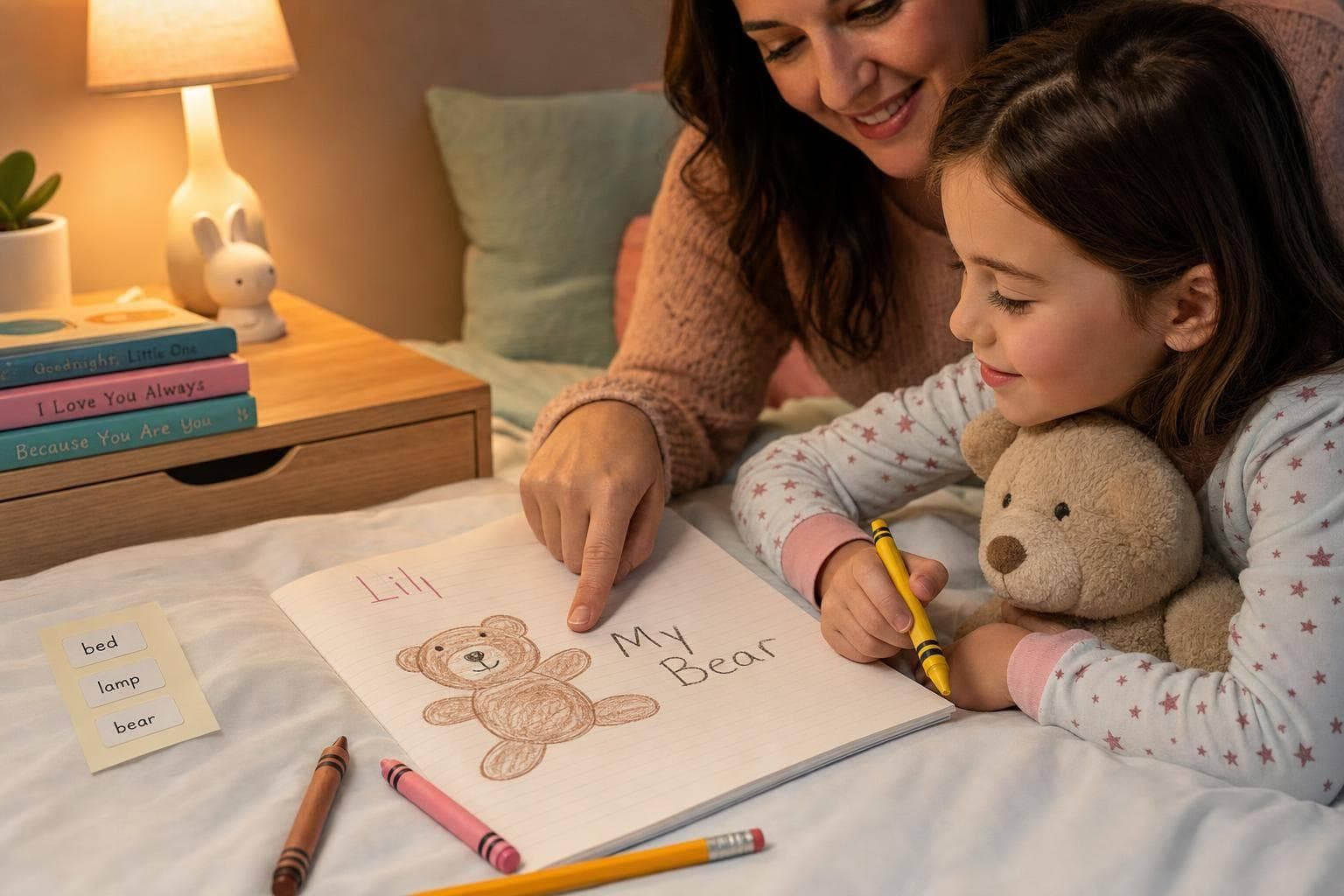
How Personalized Stories Encourage First Writing
The short answer: if I want a young child to move from listening to a bedtime story to putting words on paper, I keep the routine small: talk, draw, label, write.
Most young kids do not need to start with sentences. They do better when I break writing into tiny steps they can handle. A child can first retell the story out loud, then draw one part, then add one word, and later make one short page. That is often enough to turn story time into early writing practice at home.
Here’s the whole idea in one glance:
- Step 1: ask simple retelling questions
- Step 2: let the child draw one favorite scene
- Step 3: add a label, title, or copied word
- Step 4: help the child make one page per night
- Step 5: use dictation, tracing, copying, or sound-based spelling if needed
This matters because early writing starts long before full sentences. In the U.S., many children begin with scribbles, shapes, letter-like marks, and copied names before they write on their own. Research on early literacy often shows that oral language, drawing, and print awareness support later writing.
What helps most? A story the child cares about. When the story includes the child’s name, favorite things, or familiar places, it is often easier for them to remember details and talk about what happened.
| Part | What I do | What the child does |
|---|---|---|
| Talk | Ask “Who?” “Where?” “What happened next?” | Retells the story |
| Draw | Pick one scene only | Draws one moment |
| Label | Offer one word or short title | Traces or copies it |
| Write | Help with one short page | Adds a word or dictates a sentence |
One short page a night is enough. The goal is not perfect spelling or neat handwriting. The goal is to help the child start.
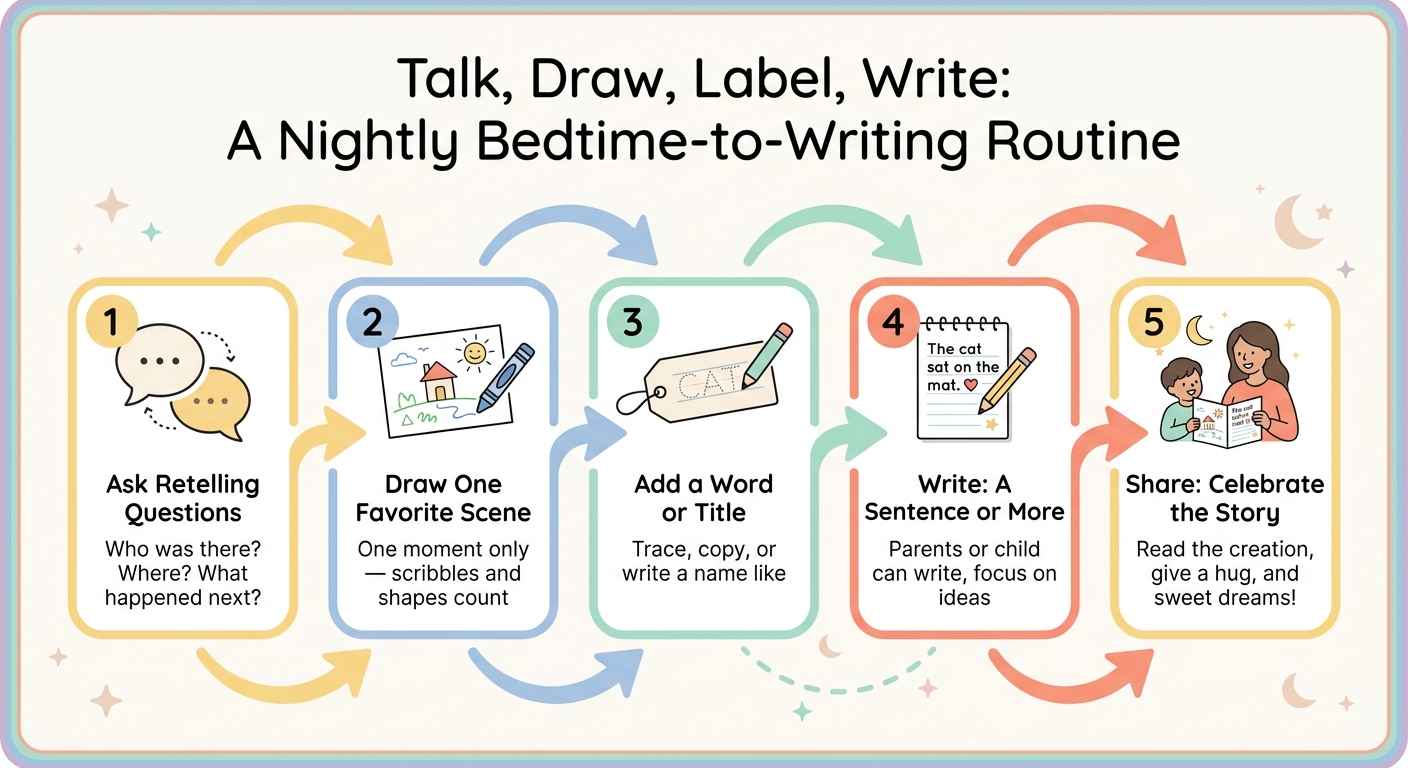
Talk, Draw, Label, Write: A Nightly Routine to Build Early Writing Skills
Solution 1: Start with oral retelling before asking a child to write
After the story ends, ask your child to tell it back in their own words.
Use simple prompts like:
- Who was there?
- Where did it happen?
- What happened next?
This gives your child a clear starting point. If they can say the story out loud, the next step usually feels much easier.
From there, they can draw the scene or copy a few words. Speaking first helps take the pressure off writing and turns the task into something more doable.
sbb-itb-d6d0693
Solution 2: Turn story scenes into drawings, labels, and copied words
After your child retells the story, shift to drawing. This works well because drawing feels easier than writing. There are no letters to form, no spelling to get stuck on, and no pressure to get every mark “right.” At the same time, it still helps with story recall and builds the hand control kids need later for letters. Scribbles, rough sketches, and simple shapes all count.
Draw one favorite scene and add a title or label
Ask your child to draw one moment from the story, not the whole thing. Keep it simple. For example: the dragon flew over the mountain.
When they finish, ask what’s happening in the picture. Then add a small writing step. Suggest one word or a short label. You can write it lightly in pencil and let them trace it, or point to a word in the story and let them copy it under the drawing.
Labels can be as simple as moon, bed, house, or a character’s name at the top as a title. One word over a picture may seem small, but it’s a strong first move into writing.
Copy meaningful words from the story, starting with names
Kids are often more willing to write words that mean something to them. If a child sees their own name in a story, along with a favorite animal or place, they have a clear reason to pick up a pencil.
Start with the child’s name. Then try a character name. After that, move to a repeated phrase from the story. The path is simple:
- tracing
- copying
- writing it on their own
That leads naturally into short, child-made pages.
Pick the right early writing step for your child's age
Not every child is ready for the same kind of task. Go with the step that fits where your child is right now:
- Drawing only
- Drawing + one label
- Copying one word or short phrase
The goal isn’t perfection. The goal is steady, low-pressure time with words on a page.
Solution 3: Help children name characters and make short story pages
After children can draw a scene and copy a word, you can nudge them from retelling into making a short page of their own. That shift matters. A child starts to feel like an author when they name a character and build even one page around that choice.
Letting a child name characters builds ownership of story ideas
Ask your child to pick a character's name or swap the one already in the story for a new one. It's a small move, but it changes the feel of the activity. Instead of just borrowing a story, the child starts shaping it.
You can also add one describing word. "Brave Maya" or "Sleepy Leo" written next to a drawing is a strong early writing step. It helps build description skills without the pressure of writing a full sentence. And just like that, one name choice can become the center of a child-made page.
Make one child-made page per night
Keep it simple: one page each night. A drawing, one name or label, and one word or a dictated sentence is enough.
Over time, those pages can start to line up like a short story sequence. That's where things get fun. One page becomes two, then three, and soon the child can see a story taking shape right in front of them.
Adult scribing, shared writing, and invented spelling all support early authorship
If children aren't ready to write on their own yet, that's fine. They can dictate their ideas to a parent, and the parent can write the words down. Shared writing works too.
Invented spelling counts as early authorship as well. If a child writes the sounds they hear, they're still doing the work of turning ideas into words on a page.
Conclusion: A simple bedtime-to-writing routine parents can repeat
Personalized bedtime stories can make those first steps into writing feel simple and doable. The routine is easy to follow: talk, draw, label, write. Each part is small, so it can fit into a normal evening without turning bedtime into one more thing on a busy parent’s list.
Key takeaways for a realistic evening routine
Start with this sequence: talk, draw, label, write. One short page a night is enough to help build confidence.
Put the focus on confidence, not correctness. Adult scribing, shared writing, and invented spelling can all support early attempts at authorship without making kids feel pressured to “get it right.”
Kidooki gives parents a new personalized bedtime story each night, which means there’s always ready-made material for retelling and writing. Used nightly, this short routine turns story time into writing practice.
One short page a night is enough to build the habit.
FAQs
What age is best to start this routine?
You can start as soon as your child shows interest in stories and storytelling.
This routine starts with simple steps, like oral retelling, drawing scenes, and naming characters. That makes it a good fit for early reading and writing skills. As your child gets more comfortable, they can build confidence by copying favorite words and putting together short pages of their own.
What if my child refuses to write?
Keep things light and interactive. Let your child retell the personalized bedtime story out loud, then draw their favorite scene.
After that, invite them to copy a few words they liked most or help come up with names for the characters. You can also turn their ideas into short, child-made pages with one picture and one sentence, then save them as a little storybook. Kidooki’s personalized stories can help spark these ideas and conversations.
How long should this take each night?
The article doesn’t give a fixed bedtime slot, but 15–20 minutes is a solid guide for the whole routine.
That short window covers the full flow: oral retelling, a quick drawing, copying a few favorite words, naming characters, and finishing with one short child-made page.