
Dialogic Reading: Step-by-Step Guide
Want your child to talk more during story time? Dialogic reading is a simple way to do that: I ask short questions, let my child answer, and build on what they say. For kids ages 3 to 6, even 10–15 minutes at bedtime can help with word learning, story understanding, and attention.
Here’s the whole idea in plain English:
- I pick a book with clear pictures, simple plots, and repeat lines
- I keep bedtime reading short, calm, and routine-based
- I use PEER on each page:
- Prompt
- Evaluate
- Expand
- Repeat
- I use CROWD to choose question types:
- Completion
- Recall
- Open-ended
- Wh- questions
- Distancing questions
- I match prompts to my child’s age and energy level
- I keep the reading child-led, not like a test
A few things matter most: ask one short question at a time, pause at natural spots, and stop before your child gets worn out. For younger kids, simple naming and finish-the-line prompts work best. For older preschoolers, I can add recall, prediction, and short why/how questions.
Bottom line: I don’t need to talk less by saying nothing. I need to talk less by making room for my child to join in. That’s what turns reading into a back-and-forth, not a one-way read-aloud.
This guide walks through the setup, the question types, a page-by-page routine, and bedtime tips I can use tonight.
Quick Tip | Dialogic Reading "PEER"
sbb-itb-d6d0693
How to Set Up a Good Reading Session
Pick a book, place, and time that make conversation feel easy. When the book fits and the room feels calm, back-and-forth reading comes much more naturally. A good starting point is any book that gives your child something to notice, name, or guess before the next page turns.
How to Pick Conversation-Friendly Books
Look for books with clear pictures, simple storylines, repeated phrases, and themes your child already knows. Those details give kids plenty to point at, comment on, predict, and talk about without feeling overloaded.
It also helps to reread favorites. When children already know the story, they can spend less energy following the plot and more energy talking about what they see and think.
Before you start, do a quick page-by-page gut check: Does this page have enough detail to ask a question about? If the answer is yes for most of the book, it’s a strong pick for dialogic reading.
Once the book makes sense, set up the time and space so it feels familiar from one night to the next.
How to Set Up a Calm Bedtime Reading Routine
Set a regular start time, dim the lights, and clear out distractions.
Keep the session to 10 to 15 minutes. That’s enough time for a short conversation around the story, but not so long that it pushes past a preschooler’s low-energy bedtime window.
Print Books, Wordless Books, or Narrated Stories: Which to Use
If a story gets your child talking, the format matters less. Print books, wordless books, and narrated stories can all work.
Print picture books are easy to use because you can stop at any point and talk. Wordless books work especially well because the child has to tell the story from the pictures, which naturally leads to more talking. Narrated stories, like those on Kidooki, can work the same way if you pause the audio, ask a short question, and then press play again. That keeps the child doing most of the talking.
You can also rotate formats based on your child’s mood and energy.
How to Do Dialogic Reading Step by Step
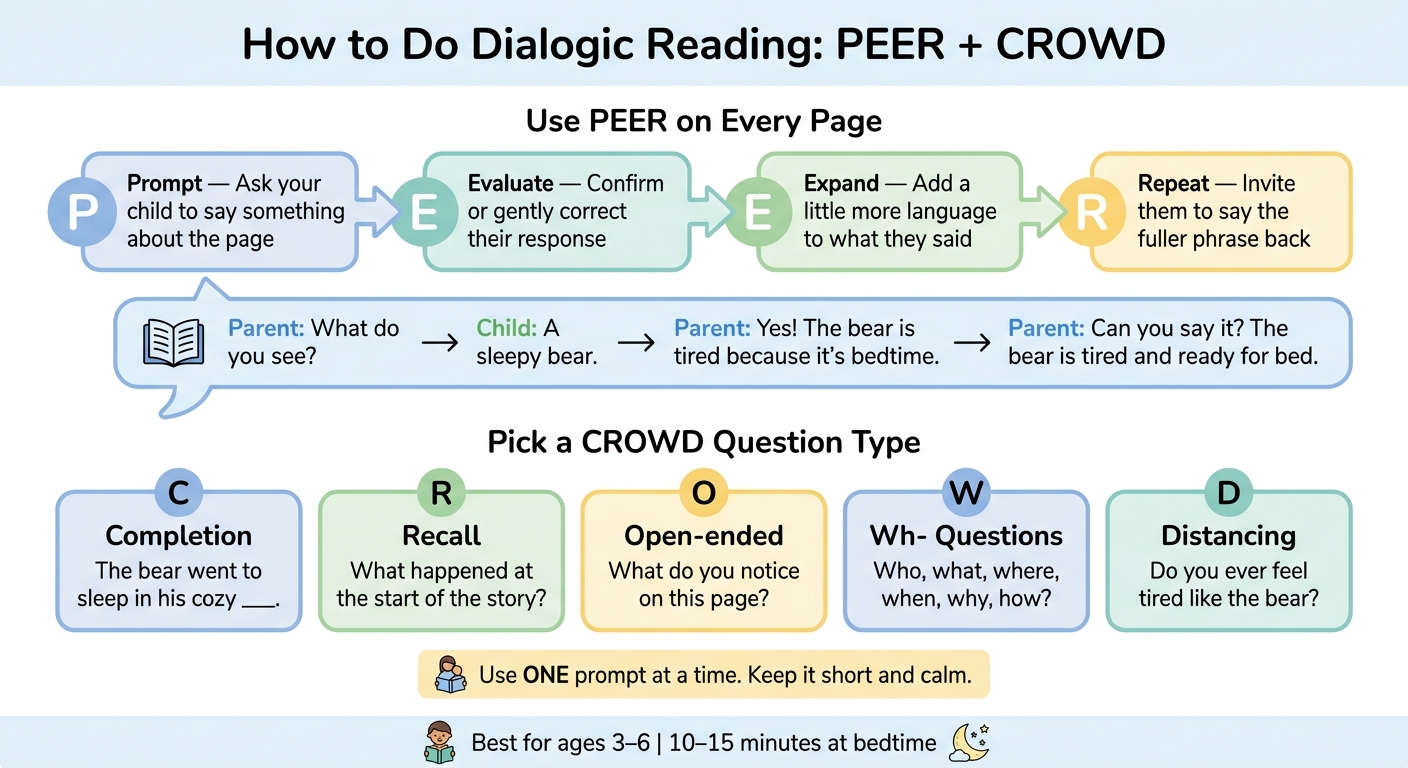
Dialogic Reading: PEER & CROWD Method Explained
Use PEER to guide each page, and CROWD to pick the kind of question that fits the moment.
How to Use the PEER Sequence on Each Page
PEER stands for Prompt, Evaluate, Expand, Repeat. On each page, you:
- Prompt your child to say something about the book.
- Evaluate the response with a short confirmation or correction.
- Expand by adding a little more language.
- Repeat the idea in a fuller phrase.
The flow is simple. Your child says something, you respond, then you help stretch that idea just a bit. That keeps the reading back-and-forth easy instead of turning it into a quiz.
How to Ask Better Questions With CROWD Prompts
CROWD gives you a small set of question types to pull from:
- Completion: Let your child finish a familiar phrase.
- Recall: Ask about something that happened earlier in the story.
- Open-ended: Ask what your child notices or thinks.
- Wh-: Ask who, what, where, when, why, or how.
- Distancing: Connect the story to your child's life.
Use one CROWD prompt at a time, then move through PEER in just a few words. Short exchanges often work best, especially when your child is tired or ready to turn the page.
A Full Dialogic Reading Example From Start to Finish
Here’s one full PEER cycle on a single page:
Parent: "What do you see on this page?" Child: "A sleepy bear." Parent: "Yes, a sleepy bear." (Evaluate) Parent: "The bear is tired because it's bedtime." (Expand) Parent: "Can you say it? The bear is tired and ready for bed." (Repeat) Parent: "What do you think happens next?"
That last question works as a distancing or open-ended CROWD prompt, and it naturally starts the next PEER loop on the following page.
Keep the exchange brief and calm. The next section shows how to adjust it by age and bedtime energy.
How to Adjust Dialogic Reading for Your Child's Age and Bedtime Energy
At bedtime, the goal is simple: keep reading calm, short, and cozy. Pay attention to your child’s energy, and stop before the back-and-forth starts to feel like a task. Let your child set the pace. Some nights they’ll want to chime in. Other nights, they’ll just want to listen. Both are fine.
Which Prompts Work Best for Ages 3, 4, 5, and 6
The big shift by age is how much back-and-forth you ask for.
Ages 3–4 usually do best with completion and naming prompts. These are easy, low-effort ways to join in, which matters when your child is winding down.
Ages 5–6 can usually handle simple recall, prediction, and short why/how questions. Still, bedtime is bedtime. If your child is sleepy, keep prompts short and light. If they seem more awake, you can add a bit more conversation.
Familiar stories also help. When a child already knows the book, it takes less effort to respond, even when they’re tired. And the calmer the bedtime mood, the simpler the prompt should be.
How to Keep Bedtime Reading Calm and Interactive
Pause at natural moments, ask one short recall or prediction question, then move on with the story.
That small pause is often enough. You don’t need to turn every page into a discussion. A quick question here and there keeps your child involved without breaking the relaxed feel of bedtime reading.
How Personalized Stories Help
When energy is low, personalization can make responses come more easily. If a story uses your child’s name or lines up with their interests, they often need less prompting to join in.
Kidooki personalizes stories with a child's name and interests, giving parents easy anchors for distancing prompts. Its age-appropriate content and narration help keep the bedtime routine calm.
Conclusion: Keep It Short, Consistent, and Child-Led
Dialogic reading is simple: let the child take the lead, then build on what they say. Even a few minutes each night can help support language growth and build confidence. Keep it short, steady, and child-led.
FAQs
What if my child won’t answer?
Don’t pressure them. Pause, give them a little more time to process, then step in with a simple response like “Yes, you’re right, because...”
Use easier, concrete questions such as “Do you see the cat or the dog?” You can also model short answers like “I think...” or “It feels...” Keep things positive, and then move smoothly to the next page.
How often should I use dialogic reading?
The search results provided don’t include material from the article, and they don’t say how often dialogic reading should be used.
So, based on those results alone, there isn’t enough information to answer the question with confidence.
Can I use dialogic reading with longer books?
Yes. Dialogic reading can work with longer books too. The main idea stays the same: use back-and-forth prompts, and break the book into smaller parts, like a few pages or one short scene at a time.
Think of each part as one turn in the conversation. You read a bit, pause, ask a question, listen to the response, and then keep going. That makes the interaction easier to handle and helps keep the reader engaged as the story moves along.